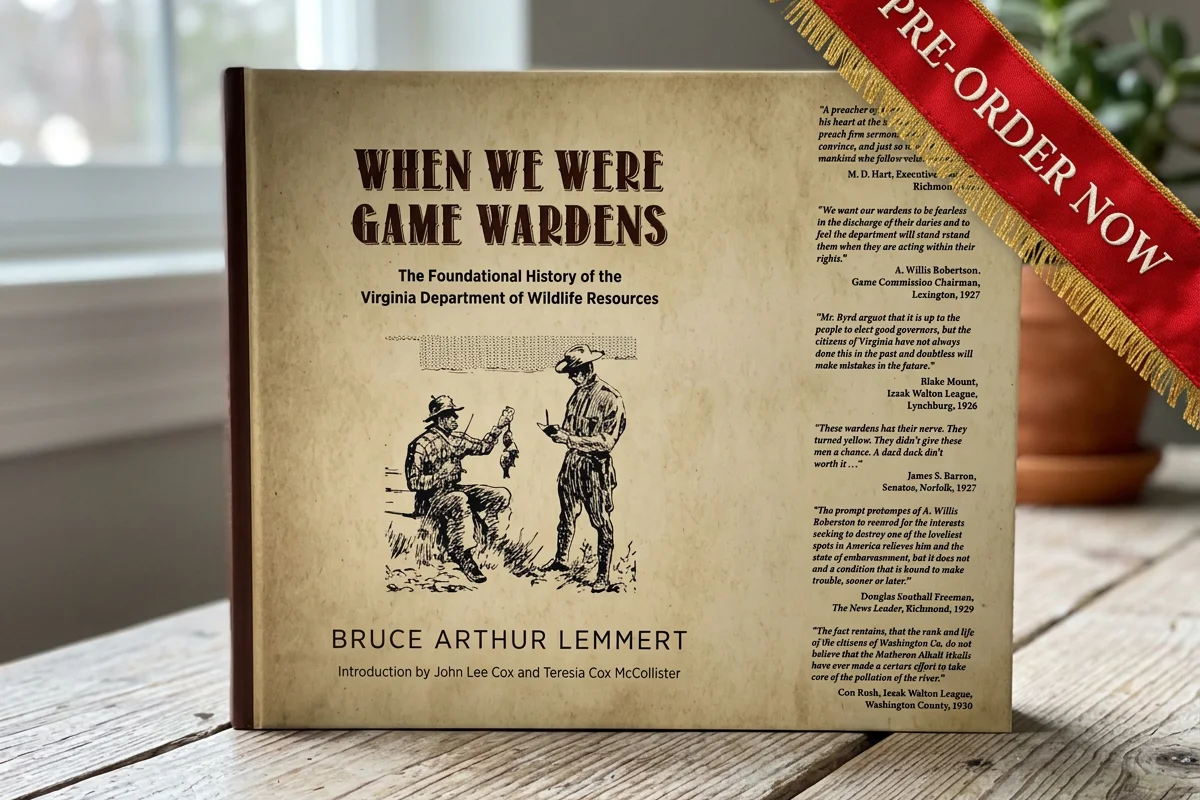
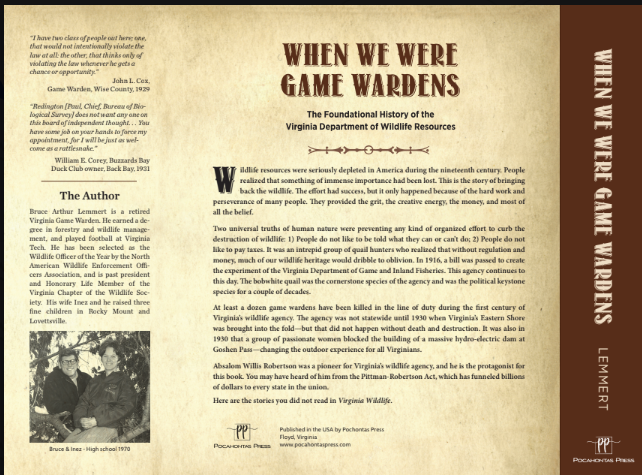
When We Were Game Wardens: The Foundational History of the Virginia Department of Wildlife Resources. By, Bruce Arthur Lemmert
Wildlife resources were seriously depleted in America during the nineteenth century. People realized that something of immense importance had been lost. This is the story of bringing back the wildlife. The effort had success, but it only happened because of the hard work and perseverance of many people. They provided the grit, the creative energy, the money, and most of all the belief.
Two universal truths of human nature were preventing any kind of organized effort to curb the destruction of wildlife: 1) People do not like to be told what they can or can’t do; 2) People do not like to pay taxes. It was an intrepid group of quail hunters who realized that without regulation and money, much of our wildlife heritage would dribble to oblivion. In 1916, a bill was passed to create the experiment of the Virginia Department of Game and Inland Fisheries. This agency continues to this day. The bobwhite quail is the cornerstone species of the agency. Fisherman, through the Izaak Walton League and the Department, organized the first effort to clean pollution from Virginia’s streams.
The agency was not statewide until 1930 when Virginia’s Eastern Shore was brought into the fold—but that did not happen without death and destruction. At least a dozen game wardens have been killed in the line of duty during the first century of Virginia’s wildlife agency.
It was also in 1930 that a group of passionate women blocked the building of a massive hydro-electric dam at Goshen Pass—changing the outdoor experience for all Virginians.
Absalom Willis Robertson was a pioneer for Virginia’s wildlife agency, and he is the protagonist for this book. You may have heard of him from the Pittman-Robertson Act, which has funneled billions of dollars for wildlife to every state in the union. Much of our primary source material for these true stories came from the Lexington law office of A. Willis Robertson. As chairman of the citizen board of Virginia’s wildlife agency, Robertson ran the day-to-day operations for almost seven years. Politics was ever present, but Robertson believed in hiring the best. He implemented an intelligence test for all game wardens to at least partially get beyond the political pressure to hire glad-handing sycophants, or people seeking a sinecure. He went out of state to hire Virginia’s first wildlife biologist, naturalist, and fisheries biologist—all three of whom were from among the best in the United States.
It is presumed to be Rudyard Kipling that said, “If history were taught in the form of stories, it would never be forgotten.” With that idea in mind, this book was written.
Here are the stories you did not read in Virginia Wildlife.
Free shipping on three or more books!